

When water is pouring through your ceiling or pooling in your basement, you do not have time for a long research project. But the company you hire in the next hour can affect how your home dries, how much your insurance pays, and whether mold shows up a month later. Knowing how to choose a water damage restoration company ahead of time, or at least in the first few minutes of a crisis, protects your home and your wallet.
This checklist is written for Baltimore homeowners. It covers what to look for, what to ask, and what warning signs should make you keep dialing.
Why the Choice Matters
Water damage is not just a cleaning job. It is a drying and building-science job. A crew that extracts the visible water and leaves without checking moisture inside walls can leave you with hidden damage. A crew that works fast but does not document anything can leave you fighting with your insurer. And in a disaster, some people take advantage of homeowners who are rushed and stressed.
Taking a few minutes to compare companies is worth it. Here is what to check.
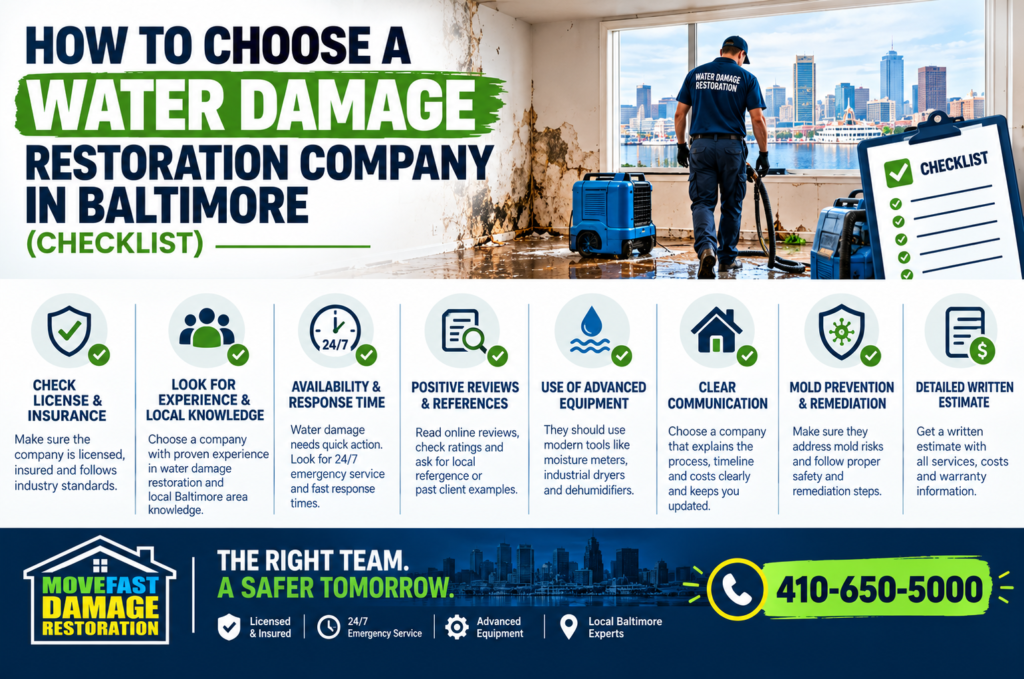
Checklist Item 1: Fast Response and Real Availability
Water damage gets worse by the hour, so ask how quickly someone can actually be at your home. A company that answers the phone but cannot send a crew until tomorrow may not help much. Ask for a realistic arrival window and whether they will tell you if they are running late.
Checklist Item 2: Proper Licensing and Insurance
Ask whether the company holds the licenses required for its work in Maryland and whether it carries liability insurance and workers compensation coverage. If a worker is hurt in your home or something is damaged during the job, you want to know who pays. A legitimate company will give you this information without hesitation.
Checklist Item 3: Training and Industry Standards
Ask what training the technicians have and what drying standards the company follows. Water damage restoration is a technical field with accepted practices for extraction, drying, and documenting results. A good company can explain its process in plain language. Be careful with vague claims. If a company says it holds a certification, ask for the details and proof.
Checklist Item 4: Professional Equipment
The right tools make a big difference. Ask whether the crew uses moisture meters, air movers, dehumidifiers, and extraction equipment, and whether they monitor moisture readings over the course of the job. If they plan to drop off a couple of fans and come back in a week, that is a red flag.
Checklist Item 5: Clear Documentation
Your insurance adjuster will want records: photos, moisture readings, equipment logs, and a description of the work. Ask the company how it documents the job and whether it will share those records with you and your insurer. Good documentation protects you.
Checklist Item 6: Experience With Insurance Claims
Ask whether the company is familiar with working alongside insurance carriers. They cannot promise your claim will be approved, and you should be cautious about anyone who does. But a company that knows what adjusters look for can help the process go smoothly.
Checklist Item 7: A Written Estimate Before Work Begins
Ask for a written scope of work and estimate. In an emergency, some work, such as extraction, may start right away, but you should still understand what is being done and roughly what it will cost. Watch for companies that refuse to put anything in writing or that ask for a large payment up front.
Questions to Ask a Restoration Company
Keep this short list by your phone. These questions to ask a restoration company help you compare options quickly and cut through sales talk.
- How soon can a crew be at my address?
- Are you licensed and insured in Maryland? Can you send proof?
- Who will actually be working in my home, your employees or subcontractors?
- What is your process for finding hidden moisture?
- What equipment will you use, and how often will you check the readings?
- How long do you expect drying to take?
- How will you document the work for my insurance company?
- Will you give me a written estimate before work starts, and how are changes handled?
- Do you handle the rebuild, or only the drying and cleanup?
- Can you provide references or recent reviews from Baltimore customers?
Water Damage Restoration Checklist: Quick Version
Use this water damage restoration checklist when you are comparing two or three options side by side.
- Responds quickly and gives a real arrival time.
- Shows proof of licensing and insurance.
- Explains its drying process clearly and uses moisture monitoring.
- Uses professional extraction and drying equipment.
- Documents everything with photos and readings.
- Gives a written scope and estimate.
- Is open about whether work is done by employees or subcontractors.
- Has local references and a real Baltimore presence.
Red Flags to Watch For
- Pressure to sign a contract on the spot before anyone has looked at the damage.
- A demand for full payment up front.
- A quote given over the phone with no inspection, for a job that clearly needs one.
- Door-to-door offers after a storm from crews you did not call.
- No mention of moisture readings or monitoring.
- Promises about insurance approval.
- Vague answers about licensing, insurance, or training.
- Unwillingness to provide references.
Should You Pick the Company Your Insurer Recommends?
Your insurer may suggest a company, and that is fine to consider. But in most cases you are free to choose your own contractor. Ask your insurance company what your policy says. Whoever you pick, apply the same checklist.
Local Matters in Baltimore
A local team knows the area. Baltimore has a mix of older rowhomes, basements below the water table, and neighborhoods with aging plumbing. A crew that works in the area regularly knows what to expect and can arrive faster than one coming from far away. Ask where the crew is based.
What a Good First Visit Looks Like
When the right team arrives, you should see a clear sequence. They should walk through the home, identify the source and the type of water, measure moisture in the affected areas, explain the plan, and get you to approve the work. Extraction usually starts right away, followed by setting drying equipment and scheduling checks. You should leave that first visit knowing what happens next and when.
Do Not Wait
It can be tempting to wait until morning or to call around for days to find the lowest price. But while you wait, the water spreads and the damage grows. Make a few quick calls, use the checklist, and choose a team you trust.
A Word About Price
Cost matters, and it is fair to ask about it. Just be careful about comparing only the bottom line. Two estimates can look very different because one includes daily moisture monitoring, proper dehumidification, and documentation while the other quietly leaves them out. Ask each company to explain what the number covers, how changes are handled if more hidden damage turns up, and what happens if drying takes longer than expected. A clear, itemized answer is usually a better sign than the lowest figure.
Trust Your Read of the Conversation
Pay attention to how the person on the phone treats you. Do they ask about the source of the water, how long it has been there, and whether anyone is safe? Do they explain things plainly, or hurry you toward a signature? Restoration is a service you are buying at a vulnerable moment, so a team that takes time to answer your questions now is more likely to keep communicating when the job is underway.
To see how we handle water damage jobs, visit our water damage service page.